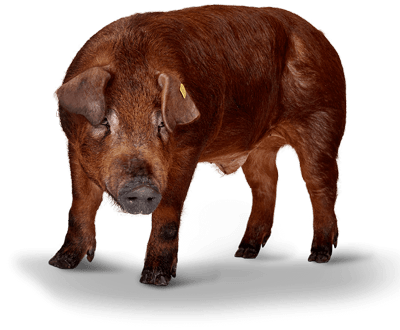
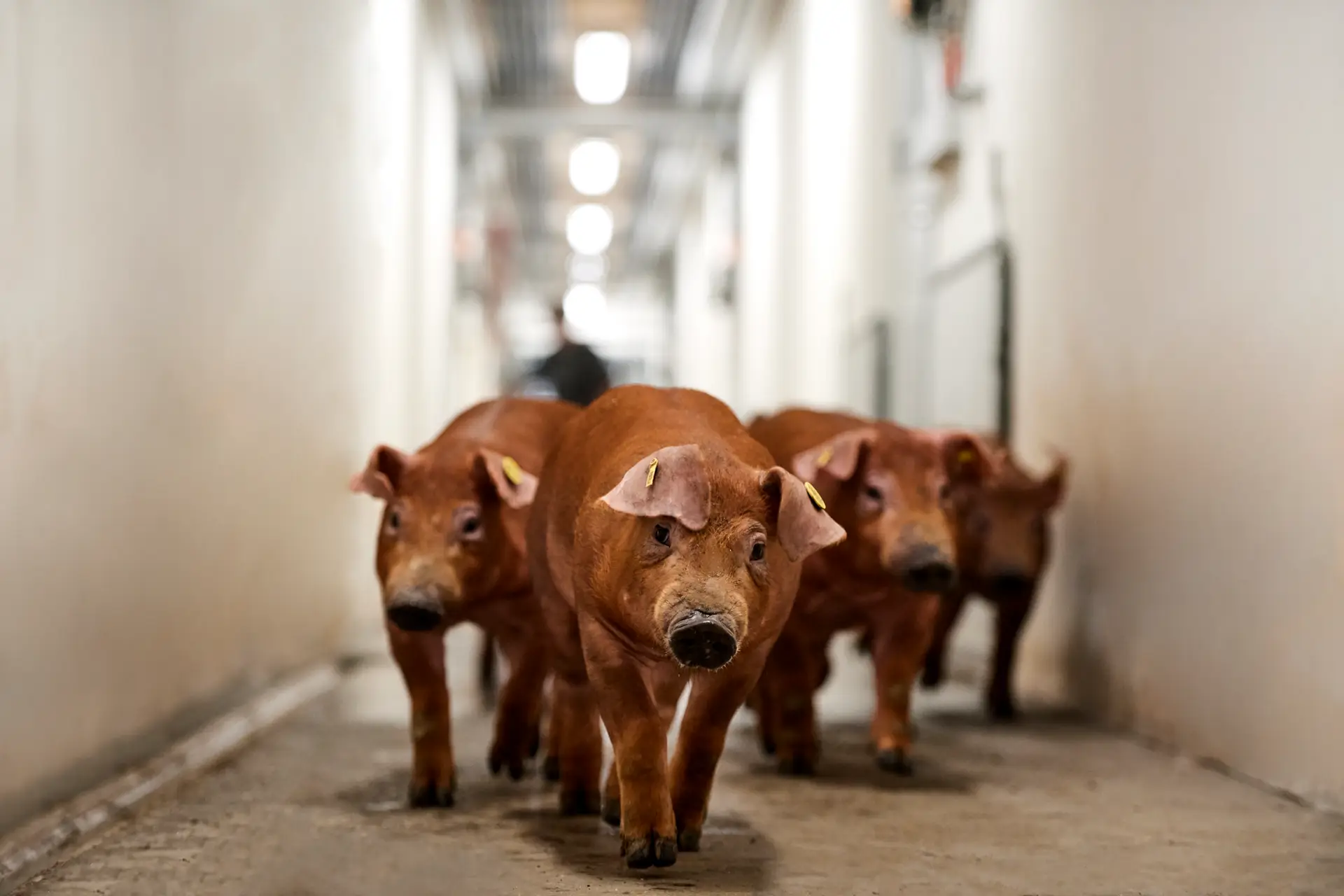
DanBred finishers consume less feed, emit less CO₂, and the latest results from the test station Bøgildgård show that all three DanBred breeds are below 1.8 kg feed per kg gain. At the same time, a new project is investigating how feed efficiency can be improved even further.
Many years of breeding for feed efficiency have made the DanBred finisher one of the most feed efficient finishers in the world. Today, a DanBred finisher consumes 29 kg less feed than it did just 14 years ago. This results in significant economic savings on what is probably the largest cost for pig producers – feed.
Lower feed intake also means that the DanBred finisher emits 40 kg less CO₂ equivalents than it did 14 years ago.
The pig’s individual feed efficiency is measured at DanBred’s test station, Bøgildgård, using automatic feeders in the pens. The latest results from Bøgildgård show that average feed efficiency is now below 1.8 kg feed per kg gain across all three DanBred breeds. In 2025, the average feed efficiency for DanBred Duroc was 1.69 kg feed per kg gain.
Focus on development
DanBred’s Research & Development department has just completed a new project on the pig’s ability to digest the feed it consumes. The project investigated whether it is possible to improve the pig’s feed utilization even further by focusing on its ability to absorb nutrients from the feed.
“Every day, we work to develop the breeding goal and ensure that we can deliver a high annual genetic gain. In that context, it is important that we continuously investigate all parameters – including those that already show strong progress. In this way, we can contribute to the work in the barn through genetics, with a clear focus on the producer’s bottom line,” explains Christian Sørensen, Chief Scientist in the Research & Development Department.
Optimal utilization of feed
In collaboration with Aarhus University, DanBred’s R&D analyzed 1,100 fecal samples collected from boars at Bøgildgård. A fecal sample reveals which nutrients the pig has not absorbed from the feed. The project examined the pig’s digestibility of energy and nitrogen, and whether these traits are heritable.
“Although the results did not show what we had hoped for, we have gained valuable knowledge about the pig’s digestibility and about what is important in the measurement methods used in the project. For example, we have already considered a completely different trial design if we were to do it again,” says Christian Sørensen.
The results showed a small heritability for nitrogen digestibility, while no heritability could be found for energy digestibility. The work on improving feed efficiency within a balanced breeding goal continues.
What actually makes a pig feed efficient?Two components contribute to a pig’s feed efficiency. One is the pig’s ability to absorb nutrients from the feed, and the other is the pig’s ability to prioritize nutrients for growth.Both components are important to improve so that the pig can utilize feed as efficiently as possible, while at the same time effectively allocating nutrients to growth and other essential processes, such as maintaining a strong immune system. |