
Improving pigs’ productivity through vital robustness is a key objective of DanBred’s breeding program. A breeding program that is designed to deliver new generations of pigs that are not only stronger and more resilient but also deliver top performance under diverse conditions.
A focus on fundamental traits such as feed efficiency, survival and reproduction within the breeding goal ensures maximum genetic progress for pig producers to benefit from.
To some, DanBred’s breeding goal might seem too straightforward. But this simplicity is intentional. By concentrating on traits that directly impact productivity and robustness, maximum genetic progress can be achieved for each trait.
Robustness and global pig production
Breeding for robustness has a significant influence on global pig production, ensuring healthy and resilient pigs throughout their whole production life. With remarkable productivity increases in pigs over the last decade, robustness has become even more important. A balanced breeding goal ensures consistent genetic progress in both robustness and productivity.
DanBred’s balanced breeding goal emphasizes improved performance while also prioritizing survival and conformation. These directly enhance the overall robustness of the pigs. By breeding for survival, we boost universal robustness by selecting for stronger immunity and resilience, supporting greater health and increased longevity in both sows and piglets.
Achieving maximum genetic progress for robustness
Robustness covers a range of traits, including productivity and health-related factors linked to challenging environments or changes in conditions. It reflects the ability to adapt effectively to such challenges. Various breeding goal traits can be defined to improve robustness.
Some breeding programs dilute genetic progress by spreading focus on a broad range of traits or a narrow focus on specific environments or diseases. All these traits serve as indicators for a specific goal. For example, breeding for an indicator trait such as birth weight, trying to enhance piglet survival instead of breeding directly for piglet survival to ensure maximum genetic progress for the trait. DanBred has a targeted breeding goal that implies to breed for the aim – in this case more surviving piglets regardless of the reason or cause of mortality. DanBred wants to improve all-around robustness against all mortality reasons.
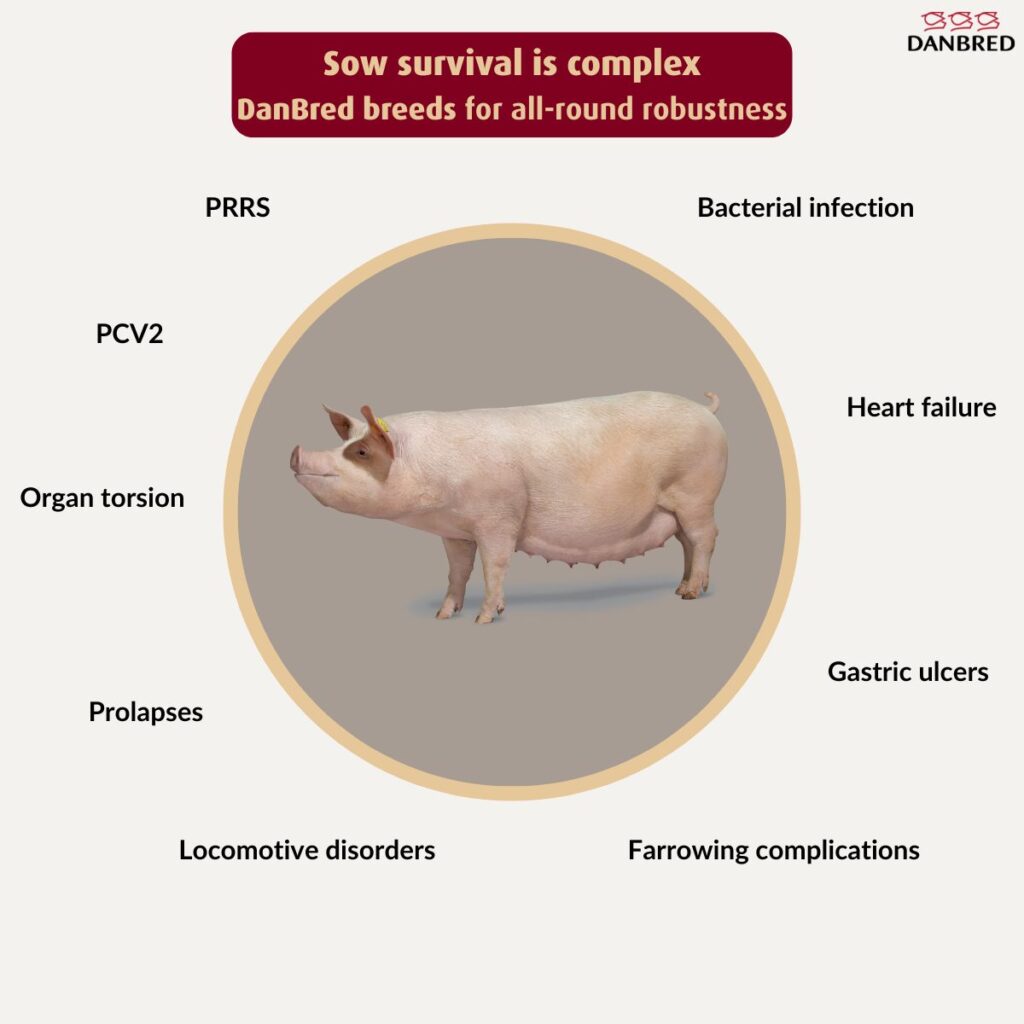
Genetic progress is not unlimited, and success cannot be measured simply by the number of traits included in a breeding goal. Including too many traits in a breeding goal can dilute progress across all of them. Achieving genetic progress depends on the quality of phenotypic data, selection intensity, and precision of statistical models used to predict breeding values and identify the best animals for future generations.
Geneticists behind DanBred’s breeding program identify and prioritise breeding goal traits by balancing the number and weighting to maintain focus and achieve maximum genetic progress.
A simple approach with direct impact
DanBred’s breeding goal may appear simple and that is by intention – as simplicity often drives strong results. By focusing on the core traits that directly drive results in the herd, genetic progress can be achieved faster and more effectively. A target breeding approach is built on a foundation of survival-based selection to enhance robustness in pigs, ensuring they thrive under diverse conditions while maintaining strong production performance.
Prioritising traits such as survival and conformation supports the development of robust pigs with high survival rates and improved overall health. A targeted approach centred on simplicity enables maximum genetic progress and ensures measurable production outcomes for pig producers. This enables producers to apply genetic advancements effectively within their own herds.
In 2024, DanBred implemented a new breeding goal trait for sow survival. This marked the first time a genetic company started using data from commercial herds to drive genetic improvements.This innovative method for measuring sow survival covers the sow’s entire productive life – from first mating to eighth parity. By breeding for sow survival, we breed for overall robustness.Sow survival has shown remarkable progress, improved with up to ten percentage points across the three DanBred purebred populations.This breeding progress is expected to be reflected in the commercial production herds within the next couple of years. |